Guild
Since 1952
Guild was founded in 1952 by Alfred Dronge and George Mann in Manhattan, New York, assembling a team of skilled craftsmen including former Epiphone employees. Initially focused on archtop jazz guitars, Guild evolved to produce some of the finest acoustic guitars in American history, with their dreadnoughts and jumbos rivaling Martin and Gibson. After production in Hoboken (1956-1966) and Westerly, Rhode Island (1966-2001), Guild was acquired by Fender in 1995 and later by Córdoba Music Group in 2014. Today, Guild continues its legacy with USA-made acoustics and the Newark St. Collection electrics.
74
Years in Business
1.5M+
Guitars Sold
$40M+
Annual Revenue
Complete Guild Guitar Price & Valuation Guide (2026)
Comprehensive market valuation ranges, mint vs used condition pricing, tonewood specs, and historical price trends for Guild guitars.
Guild Price Overview
Guild covers a wide range of instruments from entry-level to professional models. Typical used prices vary by condition, series and year. Higher-end USA models and limited editions retain value better than mass-market lines, while rare or vintage pieces often command significant premiums.
When evaluating value, consider originality (pickups, hardware), structural condition (neck, frets, finish) and documentation (serials, receipts, setup reports). Price dispersion across platforms is common; local stores offer service and inspection, whereas online marketplaces provide broader selection and price transparency.
For detailed buying advice, model comparisons and condition-based pricing, read the full guide linked above.
Market Overview
Average Price
$1,200
+4% vs last year
eBay Listings
2,200
Active listings
Sold This Month
580
+6% vs last month
Price Range
$300-$8,000
Current market range
Data sourced from eBay, Reverb, and Guitar Center used listings
Guild Timeline
Company Founded
Alfred Dronge and George Mann established Guild Guitars at 536 Pearl Street in Manhattan, staffing with former Epiphone craftsmen.
Hoboken Factory
Guild relocated to a larger facility in Hoboken, New Jersey, to accommodate growing demand.
D-55 Introduction
Debuted the flagship D-55 dreadnought, which would become Guild's most iconic acoustic guitar.
Avnet Acquisition
Avnet Corporation acquired Guild and relocated production to Westerly, Rhode Island. First Westerly guitar (M-20) produced in 1967.
12-String Excellence
Guild's F-512 and F-212 established the brand as the premier choice for 12-string acoustic guitars.
Alfred Dronge Memorial
Guild introduced special models honoring founder Alfred Dronge, who passed in 1972.
Fender Acquisition
Fender Musical Instruments Corporation purchased Guild, beginning a series of factory relocations.
Westerly Closure
The legendary Westerly factory closed; production moved to Corona, California.
Córdoba Acquisition
Córdoba Music Group acquired Guild from Fender, establishing new production in Oxnard, California under luthier Ren Ferguson.
USA Production Revival
First USA-made Guilds (M-20, D-20) released from the new Oxnard facility.
Kim Thayil Signature
Released Kim Thayil signature S-100 Polara models celebrating 70th anniversary and 30+ years of artist partnership.
Complete Guild Product Lineup
Guild: Where New York jazz heritage meets American acoustic excellence since 1952
USA Acoustic Guitars
American-made acoustics built in Oxnard, California
Flagship rosewood dreadnought at $4,199-$4,699
Premium jumbo body at $4,199-$4,699
Legendary 12-string jumbo at ~$4,399
Mahogany dreadnought at $2,599-$2,699
All-mahogany entry USA at $1,599-$1,699
Legendary Westerly RI steam-pressed arched mahogany workhorse at $650-$1,250 used
Westerly Collection
Quality imports with classic Guild DNA
Orchestra model with Guild's signature arched back
Compact archback for fingerstyle
Affordable dreadnought with electronics
Jumbo body at accessible prices
Newark St. Electric Guitars
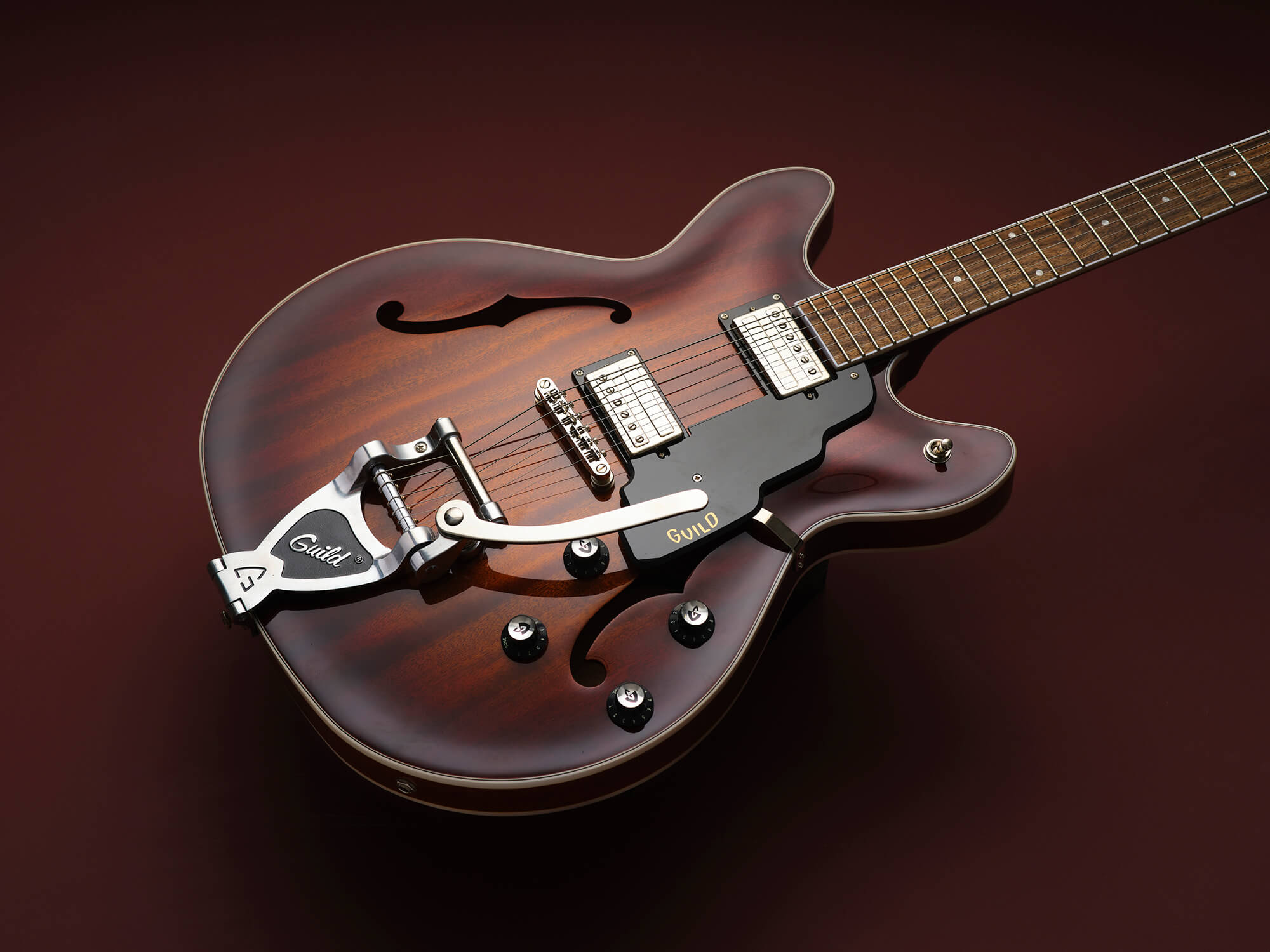
Semi-hollow and solid body electrics
Entry semi-hollow at $499-$749
Iconic semi-hollow bass with BiSonic / BC-1 pickups at $749-$1,399
Rock-focused semi-hollow at $1,399
Premium semi-hollow at $1,749
Compact hollowbody at $999-$1,199
Chambered solid body at $849
Archtop & Specialty
Jazz archtops and specialty instruments
Hollowbody archtop with DeArmond pickup
Solid body electric, Kim Thayil signature available
Mandolins, banjos, and Americana instruments
"Guild: Where New York jazz heritage meets American acoustic excellence since 1952"
Model-Specific Buying Guide
Each model has unique characteristics that affect both tone and value. Here's what to look for when buying specific models.
USA Acoustic Buying Guide
Wood Selection Matters
D-55/F-55: Rosewood for rich, complex tone. D-40: Mahogany for warm, focused sound. D-20: All-mahogany for budget-friendly USA quality
Body Style Choice
D-Series: Dreadnought for powerful strumming. F-Series: Jumbo for enhanced bass and 12-string excellence. M-Series: Smaller body for intimate playing
Bracing and Construction
USA models feature scalloped Adirondack spruce bracing and nitrocellulose finish for superior resonance and aging
Vintage Guild Buying Guide
Era Identification
Hoboken (1956-1966): Most collectible. Westerly (1967-2001): Excellent quality, great value. Post-2001: Variable by production location
Brazilian Rosewood Premium
Pre-1969 Brazilian rosewood models command 2-3x premium over Indian rosewood equivalents; verify with documentation
Condition Assessment
Check neck reset history, bridge condition, and bracing integrity—vintage Guilds often need work but are worth restoring
Starfire Electric Buying Guide
Model Hierarchy
Starfire I: Budget-friendly entry. Starfire III: Enhanced features. Starfire VI: Premium flamed maple appointments
Pickup Considerations
Guild LB-1 Little Buckers standard on most models; vintage-style P-90s available on select configurations
Center Block Construction
Starfire models feature mahogany center block for feedback resistance while maintaining semi-hollow resonance